Every work uniform you purchase travels through a supply chain. The fewer intermediaries in that chain, the lower your cost and the greater your control. Yet many companies still source their uniforms through distributors, trading companies, or multi-tier import agents — paying a premium at every step without realizing it.
This article breaks down the real differences between factory-direct sourcing and buying through a distributor, explains where the cost savings come from, and shows you how to make the switch without disrupting your operations.
Understanding the Supply Chain: Where Does Your Money Go?
A typical distributor supply chain for work uniforms looks like this:
Manufactures the garment
➔
Handles logistics
➔
Adds 20–40% margin
➔
Receives the uniform
Each intermediary adds a margin — typically 15–40% — for services that a capable factory can often handle in-house. When you source factory-direct, the chain compresses to two steps: Factory → Your Company.
The True Cost Comparison
Let’s compare the landed cost of a standard hi-vis work jacket (polyester/cotton blend, reflective tape, embroidered logo) ordered at 1,000 units:
| Cost Component | Via Distributor | Factory-Direct |
|---|---|---|
| Ex-factory garment cost | USD 14.50 | USD 14.50 |
| Agent/middleman margin (25%) | USD 3.63 | — |
| Distributor margin (30%) | USD 5.44 | — |
| Shipping & logistics | USD 2.10 | USD 2.10 |
| Total landed cost per unit | USD 25.67 | USD 16.60 |
| Savings per unit | — | USD 9.07 (35%) |
On a 1,000-unit order, that is over USD 9,000 in savings — money that can be reinvested in better fabrics, additional safety features, or simply improving your margins.
Beyond Price: 6 Advantages of Factory-Direct Sourcing
1. Full Quality Control
When you work directly with the factory, you can specify AQL levels, request in-line inspections, and receive TOP samples from the actual production run. Distributors rarely offer this level of transparency.
2. Faster Communication
Every question, change request, or approval goes straight to the people making your garments. No telephone game through three intermediaries.
3. True Customization
Distributors stock standard designs. A factory partner can develop custom OEM/ODM garments built to your exact specifications — fabric, fit, features, and branding.
4. Intellectual Property Protection
Your designs and specifications stay between you and the factory. With distributors and agents, your tech packs may pass through multiple hands, increasing the risk of design leaks.
5. Consistent Reorder Quality
Distributors may switch factories between orders without telling you. A direct relationship ensures the same production line, the same quality team, and the same materials every time.
6. Scalable Partnership
As your business grows, a factory partner can scale with you — adjusting MOQs, expanding your product range, and even developing new lines collaboratively. Distributors treat you as one account among hundreds.
Common Objections (and Why They Don’t Hold Up)
“I don’t have time to manage a factory relationship.”
A professional factory with a dedicated account manager requires less management than a distributor. You get one point of contact who understands your products, your standards, and your timeline.
“Small orders won’t be accepted by a factory.”
Many workwear factories, including UniWorkWear, accept MOQs as low as 300–500 units per style. That’s well within reach for most B2B buyers.
“Shipping and logistics are too complicated.”
Most established factories handle FOB or CIF shipping, work with international freight forwarders, and provide full export documentation. The logistics are no more complex than what a distributor does — you just cut out the middleman’s margin.
How to Transition from Distributor to Factory-Direct
- Audit your current supply chain — identify where margins are being added
- Research and shortlist 3–5 certified manufacturers (use our manufacturer selection guide)
- Request samples and compare quality against your current supplier
- Negotiate pricing with a full cost breakdown (fabric, trims, branding, packing)
- Place a trial order (300–500 units) to validate the relationship
- Evaluate quality, lead time, and communication after the trial
- Scale up with confidence
UniWorkWear: Your Factory-Direct Partner
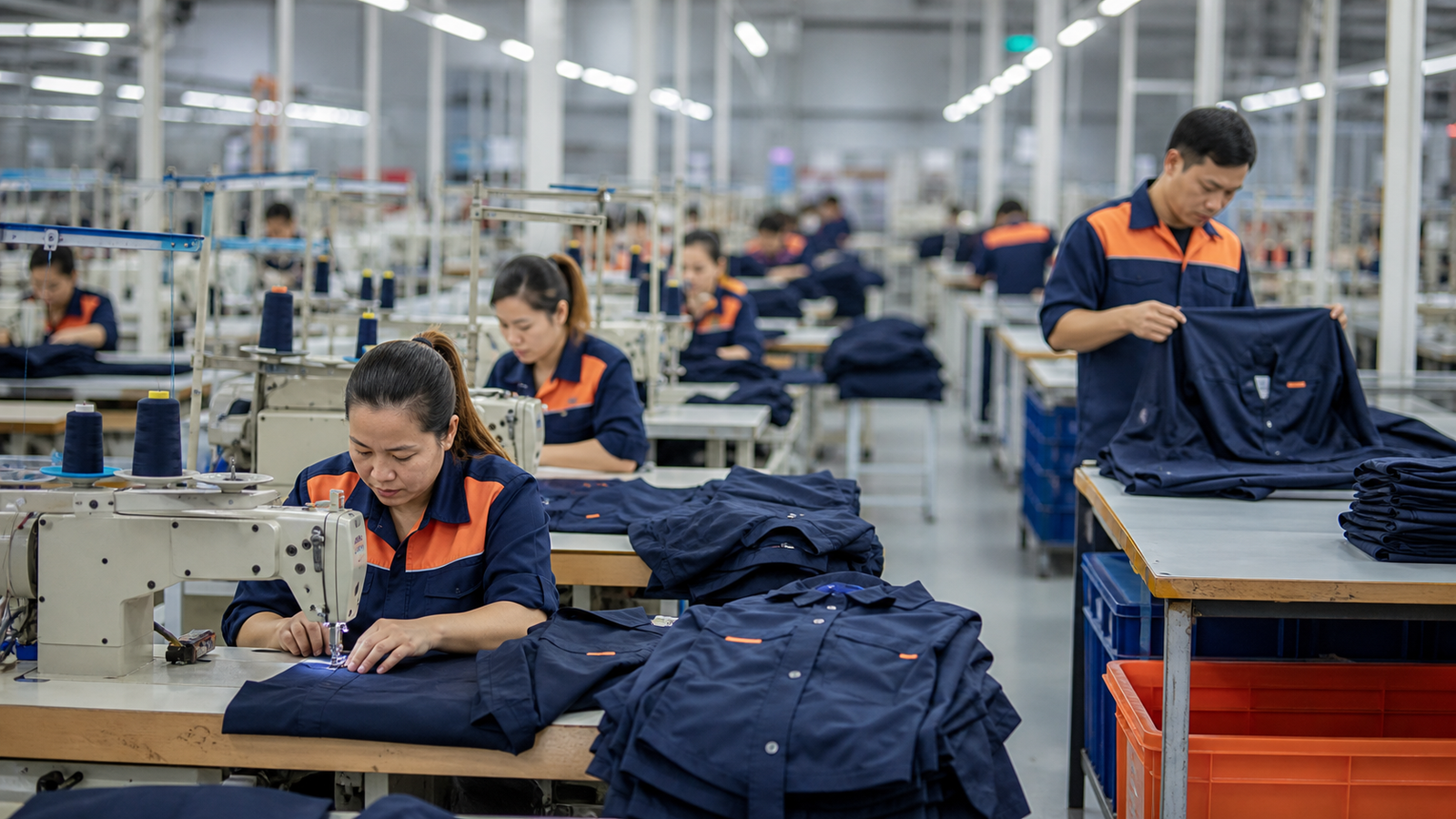
UniWorkWear is a vertically integrated work uniform manufacturer based in Shenzhen, China. We sell directly to brands, distributors, and procurement teams worldwide — no agents, no middlemen. Every order is produced in our own facility under our own quality management system.
Average savings vs. distributor pricing
Per style, with 300-piece pilot runs available
Standard production for custom orders
Plus BSCI, OEKO-TEX, and product-specific standards
Ready to cut out the middleman and source factory-direct?
Final Thoughts
The distributor model made sense when international sourcing was opaque and communication was slow. In 2026, factories communicate in real time, ship globally, and offer the same (or better) services that distributors once provided — at a fraction of the cost.
If you are still buying through intermediaries, you are leaving 30–50% of your uniform budget on the table. The transition to factory-direct sourcing is simpler than you think, and the payoff starts with your very first order.